Pergola Cost Per Square Foot: A Complete 2026 Pricing Guide
A pergola gives a bare patio or deck a real sense of place, but before you start pricing beams and posts, you need a straight answer on what it will actually run you. The short version: pergola cost per square foot typically lands between $30 and $65 installed, with DIY kits running $15 to $40 per square foot in materials. Most homeowners end up spending $3,000 to $7,000 all-in for a standard 10-by-10-foot structure, though premium louvered aluminum models can push well past $10,000.
Those ranges are wide for a reason. The material you choose, whether you hire a contractor or build it yourself, and how much shade and structure you actually want all move the final number by thousands of dollars. This guide breaks down the real per-square-foot math, material by material, so you can budget with confidence instead of guesswork.
What a Pergola Costs Per Square Foot
When contractors quote pergolas, they almost always talk in total project price rather than a clean per-square-foot rate, because so much of the cost is in the posts, footings, and labor rather than the roof area. But per-square-foot is still the most useful way to compare one material against another on a level playing field.
Here’s how the numbers shake out for a standard 10-by-10-foot (100-square-foot) pergola in 2026:
| Material | DIY (per sq ft) | Installed (per sq ft) | Typical 10×10 ft total |
|---|---|---|---|
| Pressure-treated pine | $10–$20 | $25–$40 | $2,500–$4,000 |
| Cedar | $15–$25 | $30–$50 | $3,000–$5,000 |
| Vinyl | $20–$35 | $40–$65 | $4,000–$6,500 |
| Aluminum (fixed roof) | $25–$40 | $45–$70 | $4,500–$7,000 |
The installed figure includes labor, which typically accounts for 40% to 60% of the total on a custom build. That is why the DIY column looks so much cheaper — you are buying materials only, and the biggest single line item (a carpenter’s time) drops to zero.
Why the “per square foot” number is misleading at small sizes
Pergolas don’t scale linearly. A 10-by-10-foot pergola and a 20-by-20-foot pergola use different lumber dimensions entirely: the bigger structure needs thicker posts, deeper footings, and heavier beams to carry the longer spans. That means a larger pergola costs less per square foot than a smaller one, even though the total price is higher. Use per-square-foot as a comparison tool between materials, not as a hard multiplier for your own project.
Pergola Cost by Material
Material is the single biggest driver of pergola cost per square foot, so it pays to understand what you’re actually getting for the money at each tier.
Pressure-treated pine (budget)
Pressure-treated pine is the cheapest way to get a pergola up, which is why it shows up in most big-box DIY kits. It runs $10 to $20 per square foot for materials. The trade-off is longevity and appearance: pine is soft, prone to warping and checking as it dries, and needs to be stained or sealed every couple of years. It also starts greenish and only looks good once it’s painted or stained dark. For a rental or a patio you’ll renovate in five years, it’s a sensible pick. For a permanent feature, most people upgrade.
Cedar (the sweet spot)
Cedar is the most popular pergola material for good reason. It resists rot and insects naturally, looks good left bare, and weathers to a soft silver-gray if you skip the sealer. Expect $15 to $25 per square foot for a DIY build and $30 to $50 installed. Western red cedar is the premium version; it costs more than inland cedar but holds its color and straightness better. Cedar is the material to choose if you want natural wood without a lifetime of maintenance chores.
Vinyl (low-maintenance)
Vinyl (also sold as PVC) pergolas cost more up front — $40 to $65 per square foot installed — but you’ll never paint, stain, or seal them. They wipe clean with soap and water and hold up to rain and humidity without rotting. The downside is structural: vinyl is lighter than wood, so vinyl pergolas can flex in high wind and often have weight limits on what you can hang from the beams. They’re a strong choice in coastal or humid climates where wood struggles.
Aluminum and steel (modern, premium)
Aluminum pergolas start around $45 per square foot installed and climb fast. A fixed-roof aluminum pergola is comparable to vinyl in cost, but the real price jump comes with louvered aluminum pergolas — motorized roofs that open and close on demand, like StruXure and Equinox systems. Those run $80 to $150+ per square foot installed, with a 10-by-10 unit easily exceeding $10,000. Steel pergolas are rarer for residential use and generally reserved for heavy-duty or commercial applications.
Pergola Cost by Size
The footprint of your pergola is the other half of the price equation. Here are realistic installed totals for common sizes, assuming a mid-tier cedar build:
- 8×8 ft (64 sq ft): $2,000–$3,200 — best for a small bistro set or a corner reading nook.
- 10×10 ft (100 sq ft): $3,000–$5,000 — the standard, fits a four-seat dining set comfortably.
- 10×12 ft (120 sq ft): $3,600–$6,000 — room for a dining table plus a lounge chair or two.
- 12×12 ft (144 sq ft): $4,300–$7,200 — fits a full outdoor dining setup.
- 12×16 ft (192 sq ft): $5,800–$9,600 — the starting point if you want a seating zone and a dining zone.
- 14×20 ft and up (280+ sq ft): $8,400+ — custom builds with engineered beams and deeper footings.
The jump between an 8-foot and a 12-foot span is where costs accelerate, because 12-foot spans usually require 6×6 posts and 2×10 beams instead of 4×4 posts and 2×6 beams.
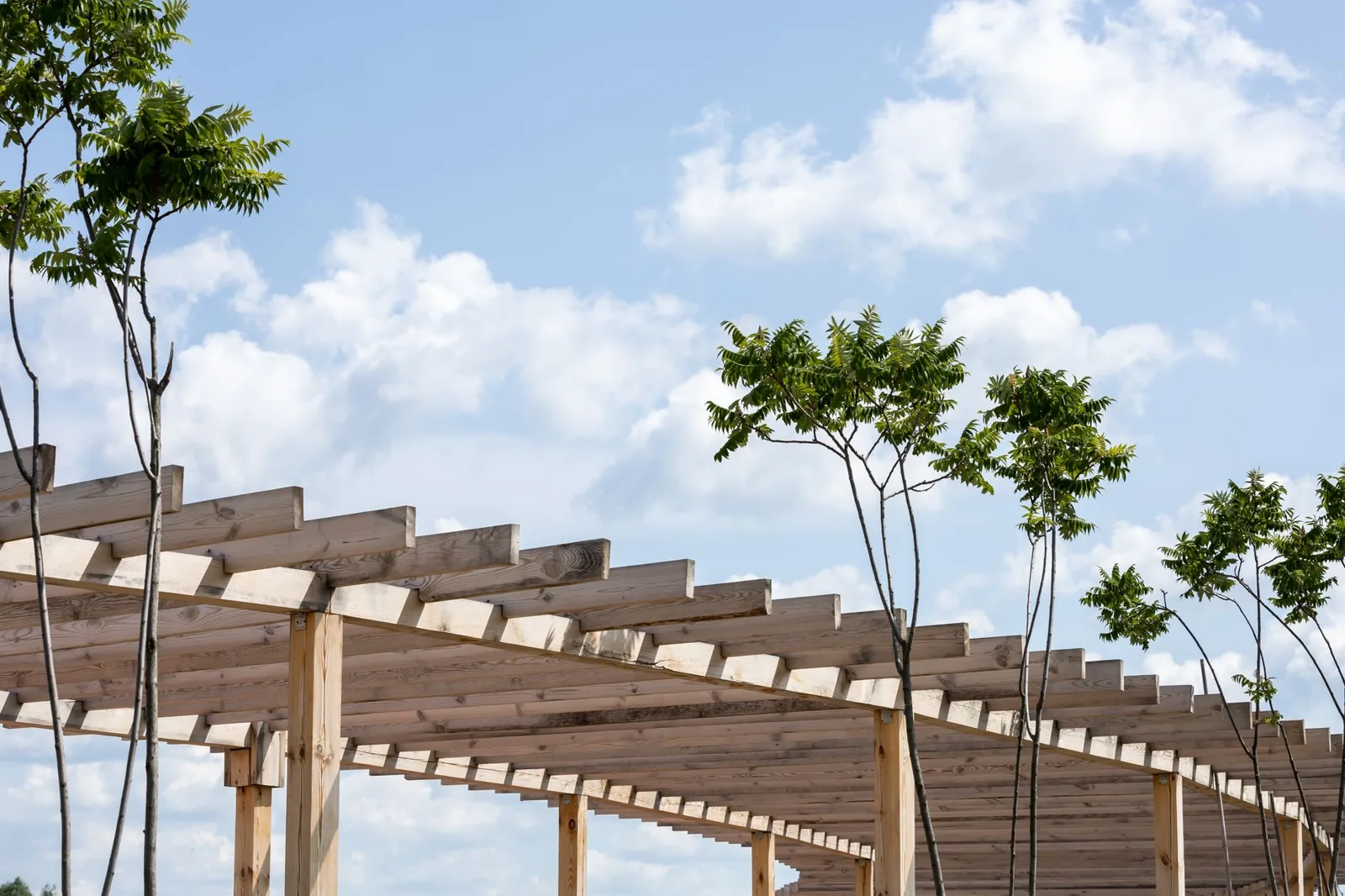
Photo by Яна Леоненко via Pexels
DIY vs. Professional Installation
The decision to build it yourself versus hire a pro is worth more than any single material choice. It’s the difference between a $1,500 project and a $7,000 one.
| Factor | DIY pergola kit | Pro custom build |
|---|---|---|
| Typical cost | $1,500–$6,000 | $4,000–$12,000+ |
| Time to complete | 1–3 weekends | 2–5 days |
| Footings included | Usually no (dig your own) | Yes, code-compliant |
| Permits handled | You | Contractor |
| Warranty | Manufacturer only | Workmanship + materials |
Big-box kits from brands like Yardistry, Backyard Discovery, and Toja Grid have made DIY dramatically easier. A Toja Grid kit, for instance, is basically precut lumber plus powder-coated steel corner brackets — you supply the wood and assemble it with a wrench. Expect $1,500 to $4,000 for a decent 10-by-10 kit, plus the cost of concrete for footings.
The catch with DIY is the parts nobody prices in: renting an auger for the footings, buying concrete, and spending a full weekend squaring and leveling. If your ground slopes or you’re attaching the pergola to the house, a professional is worth the money. A freestanding pergola on flat ground with a simple design is genuinely buildable by a competent DIYer, which is why so many homeowners go that route.
If you’re weighing a pergola against other backyard upgrades, our covered deck ideas break down how a roof changes both cost and comfort. This Old House has a useful breakdown of how attached versus freestanding framing changes the structural work involved.
Factors That Move the Price
Beyond material and size, several smaller decisions quietly add hundreds or thousands of dollars to the final bill.
Attached vs. freestanding
An attached pergola fastens to your house and needs a ledger board properly flashed to the wall. It saves you two posts and some concrete, but the flashing and any structural reinforcement usually cancel out the savings. Attached pergolas also pull a building permit more often, because they tie into the home’s structure. Freestanding pergolas are simpler to build but need four posts and four footings.
Footings and site prep
Every post needs a concrete footing that reaches below the frost line in your region. In cold climates that can mean digging four to five feet down. Flat, accessible ground keeps this cheap; a sloped yard or hard clay soil means more excavation and more concrete. Budget $50 to $150 per footing for DIY, or $200 to $500 per footing for a contractor.
Roof and shade type
An open-slat roof is the cheapest option because it uses the least material and no weatherproofing. Adding a solid roof, a retractable canopy, or a motorized louver system increases cost substantially — louvers alone can double or triple the price. If you mainly want dappled shade, stick with slats and grow vines for coverage.
Finish, stain, and extras
Cedar and pine left raw are cheapest. Staining or painting adds $300 to $800 for materials and labor on a typical pergola. Electrical for a ceiling fan or string lights adds $500 to $1,500. Privacy walls, built-in benches, and a deck or paver base underneath all push the project higher.
Location and labor rates
Labor varies hard by region. Expect to pay 30% to 50% more in major coastal metros than in the Midwest or South, and more again during spring and early summer when contractors are booked solid. Getting three written quotes is the single most reliable way to catch an inflated number.
Photo by Gene Samit via Pexels
How to Keep Pergola Costs Down
You don’t have to sacrifice the pergola to stay on budget. These moves trim real dollars:
- Buy a kit and assemble it yourself. A quality 10×10 cedar kit costs $1,500–$4,000, versus $3,000–$5,000 for the same thing professionally built.
- Build off-season. Contractors discount work in late fall and winter. You can save 10% to 20% by scheduling for November through February.
- Keep it freestanding and simple. Skip the house attachment, the electrical, and the louvered roof. A clean 10×10 cedar pergola with slats is the best value in outdoor structures.
- Choose pressure-treated pine for the posts and cedar only for the visible beams. It cuts lumber cost noticeably without changing the look much.
- Do the footings yourself. Digging and pouring four post holes is a weekend’s work and saves $800–$2,000 in labor.
- Get three quotes and compare line items, not totals. A “cheap” bid that skips permits or uses undersized lumber will cost more later.
Frequently Asked Questions
How much does a pergola cost per square foot?
Most pergolas cost $30 to $65 per square foot installed. DIY kits run $15 to $40 per square foot in materials, while premium louvered aluminum pergolas can exceed $150 per square foot. The exact number depends on material, size, and labor rates in your area.
Is it cheaper to build a pergola or buy a kit?
A kit is almost always cheaper for the same material and size, because you’re paying retail lumber prices rather than a contractor’s markup plus labor. Kits run $1,500 to $6,000; custom builds start around $4,000. If your site is flat and you’re handy, a kit is the clear budget winner.
Does a pergola add value to a home?
A well-built pergola can add curb appeal and usable outdoor living space, which helps resale appeal, but it rarely recovers its full cost in appraised value the way a deck or kitchen remodel can. Most appraisers treat it as a landscaping feature. The payoff is mostly in how much you use it, not in equity.
Do I need a permit for a pergola?
It depends on your municipality and whether the pergola is attached or freestanding. Many areas require a permit for attached pergolas or any structure over a certain height, while small freestanding pergolas may be exempt. Check with your local building department before you buy materials — retroactive permits are a hassle. Bob Vila explains which backyard structures usually trigger a permit in his permitting guide.
How long does a pergola last?
A pressure-treated pine pergola lasts 10 to 15 years with regular sealing. Cedar lasts 15 to 25 years. Vinyl and aluminum can last 25 years or more with almost no maintenance, which is why their higher upfront cost often balances out over the life of the structure.
The Bottom Line
Pergola cost per square foot is a useful starting point — $30 to $65 installed, $15 to $40 for DIY — but the number that matters is the total for your material, size, and site. A simple 10-by-10 cedar pergola on flat ground is the best value in the category at roughly $3,000 to $5,000 professionally built, or half that if you assemble a kit yourself.
Before you commit, measure your space, decide how much shade you actually want, and check whether you need a permit. For more ways to finish the surrounding space, see our deck railing ideas to tie the look together, or read up on how to build a deck on the ground if your pergola needs a level base first.