
Deck Lighting Ideas That Add Safety, Ambiance, and Value
A deck is the most-used outdoor room in most homes, but once the sun goes down, it becomes the least useful. The right deck lighting ideas change that overnight, letting you grill, host, and relax well past dark while making every step and stair safer to navigate. Whether you are lighting a new build or upgrading an existing deck, the goal is the same: layered light that does a job instead of just glowing.
You do not need a degree in electrical engineering to get this right. Many of the best options run on solar or plug-in low-voltage systems you can install in a weekend. Others are best left to a licensed electrician. This guide breaks down the options, the real costs, and the installation trade-offs so you can choose deck lighting ideas that fit your budget and your skill level.
Why Deck Lighting Matters More Than You Think
Lighting is usually the last item on a deck project list, which is backwards. Good lighting extends how many hours a day you actually use the space, and it does three specific jobs at once.
First, it is a safety feature. The Consumer Product Safety Commission consistently reports thousands of fall injuries on residential stairs and decks each year, many in low light. A recessed light on every step and a lit path to the stairs removes the biggest trip-and-fall risk on your property.
Second, it is security. A dark deck hides a back door and a first-floor window. Motion-activated floodlights or a few always-on accent lights make a home look occupied and eliminate the shadows an intruder needs to work.
Third, it is pure resale appeal. Buyers notice a deck that glows at dusk during an evening showing. It reads as finished and thoughtful, the kind of detail that makes a home feel a notch above the comparables.
Solar vs. Low-Voltage vs. Line-Voltage Lighting
Before you pick individual fixtures, pick a power strategy. The three main options differ in cost, brightness, and how much wiring they require.
| Feature | Solar | Low-Voltage (12V) | Line-Voltage (120V) |
|---|---|---|---|
| Upfront cost | $10–$60 per fixture | $20–$80 per fixture | $60–$200 per fixture |
| Wiring required | None | Light, DIY-friendly | Yes, needs an electrician |
| Brightness | Low to moderate | Moderate to bright | Brightest |
| Reliability | Depends on sun exposure | Very consistent | Very consistent |
| Best for | Posts, paths, rail accents | Stairs, railings, ambient glow | Floods, permanent fixtures |
Solar fixtures are the fastest deck lighting ideas to install because there is nothing to wire. But they only work well where the panel gets several hours of direct sun each day, and cheap solar lights dim noticeably after the first year. Buy units with replaceable batteries rather than sealed ones.
Low-voltage is the sweet spot for most homeowners. A 12-volt transformer plugs into a standard outdoor outlet and steps the voltage down to something safe enough to bury cable a few inches deep without conduit. You can run 100 to 200 watts of fixtures off a single transformer, which covers a large deck.
Line-voltage is the choice for genuinely bright floods and for fixtures that need to match an indoor lighting circuit. It always requires a permit in most municipalities and a licensed electrician, so budget $75 to $120 per hour for labor on top of materials.
The Most Popular Deck Lighting Ideas
Here are the fixtures that give you the most effect for the effort, roughly ordered from easiest to most involved.
Post Cap Lights
Post caps replace the plain wooden cap on top of a railing or stair post with a fixture that glows downward and outward. They are the single most popular deck lighting idea because they outline the entire perimeter of the deck without any visible wiring clutter.
Low-voltage post caps wire through a hole drilled into each post and daisy-chain back to a transformer. Solar versions simply sit on top. Expect to pay $15 to $45 per cap for solar and $25 to $60 per cap for wired low-voltage. For a 20-foot-by-16-foot deck with 12 posts, plan on roughly $300 to $700 in fixtures.
Recessed Stair Lights
If you install one lighting feature, make it stair lights. Recessed round or square fixtures mount flush into the riser or the side stringer and throw a soft pool of light onto each tread, so you can see the edge of every step. They are the highest-value safety upgrade on this list and cost $15 to $40 per fixture.
Under-Rail LED Strips
Peel-and-stick LED tape mounted under the top rail or under the deck boards creates a wash of light with no visible fixtures at all. Waterproof IP65 or IP67 strips rated for outdoor use run $1.50 to $4 per foot, plus a weatherproof driver. This is the go-to for decks with clean modern lines, and it doubles as subtle accent lighting for a covered deck.
String Lights and Festoon Bulbs
Cafe-style string lights draped overhead are the cheapest way to make a deck feel like a finished outdoor room. A 48-foot strand of commercial-grade festoon bulbs costs $30 to $60 and casts a warm, even glow over a seating area. Just anchor them to sturdy posts or a house-mounted cable—never to the railing, which flexes and sags.
Landscape Spotlights and Uplights
A few adjustable spotlights aimed up at a tree, a stone wall, or the underside of an umbrella add depth that in-deck fixtures cannot. Weatherproof brass or aluminum spots run $25 to $70 each and last for years. Place them at the deck’s edge rather than in the middle of the walking path.
For more on the structures these lights attach to, see our guides to deck railing ideas and floating deck ideas.
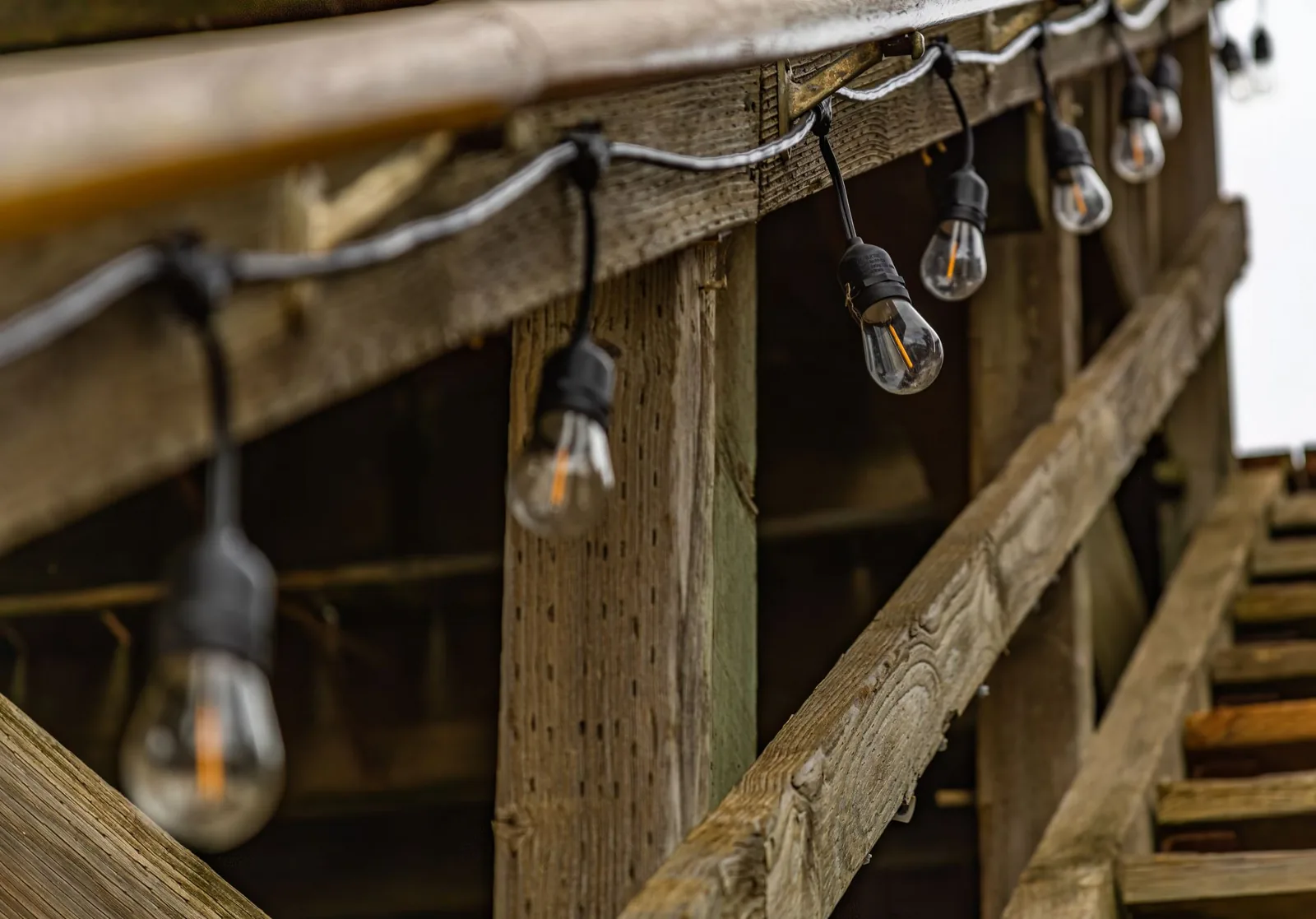
Photo by Robert So via Pexels
How Much Deck Lighting Costs
A realistic budget depends on whether you go solar, low-voltage, or full electrician-installed line voltage. Here is what a complete project looks like at three levels.
- Basic solar package ($150–$400): solar post caps, a few path lights, and a string-light strand. No electrician, no transformer, installed in an afternoon.
- Mid-range low-voltage system ($600–$1,800): a 200-watt transformer, 10 to 16 recessed stair lights, post caps, and under-rail strips. DIY-installed, this is the best value for a large deck.
- Full electrician install ($2,000–$5,000+): line-voltage floods, hardwired fixtures on a switch, and a dedicated circuit. Includes $75–$120 per hour in labor and usually a permit.
Low-voltage is where most homeowners land. The transformer costs $80 to $200, cable runs $0.50 to $1 per foot, and fixtures add up quickly, but the total still beats paying an electrician to pull line voltage. This Old House has a solid breakdown of how low-voltage wiring is laid out if you want to see the full path before you buy.
Installation Tips: DIY vs. Hiring a Pro
Solar and plug-in low-voltage kits are squarely in DIY territory. Running buried line-voltage cable is not. Here is how to tell the difference before you start.
Do it yourself if: you are using solar fixtures, a plug-in transformer, or low-voltage cable you can lay in a shallow trench. Most low-voltage systems need nothing more than wire strippers, a drill, and an afternoon.
Hire an electrician if: you are adding a new 120V outdoor outlet, hardwiring fixtures to an interior switch, or running conduit. This is also the right call if your deck is high off the ground and you are uncomfortable working on a ladder.
A few universal rules apply either way. Use only fixtures rated for wet locations (look for an IP65 rating or higher). Keep the transformer plugged into a GFCI-protected outlet. And leave a little slack at every connection point so you can swap a failed fixture without rewiring the whole run. The Family Handyman guide to outdoor lighting covers the common mistakes people make on their first install.

Photo by Pixabay via Pexels
Frequently Asked Questions
How many lumens do I need for deck lighting?
Think in layers, not a single number. Stair and path lights do their job at 50 to 100 lumens each. Post caps and accent lights land around 50 to 200 lumens. If you want to actually read or cook after dark, add a string-light or overhead layer that delivers 500 to 1,000 lumens total over the seating area.
Is solar deck lighting bright enough?
For safety accents and ambiance, yes. For task lighting, usually not. Solar post caps and path lights are fine for marking edges and stairs, but a cloudy week will leave them dim. Treat solar as a supplement to a low-voltage or string-light layer, not the whole system.
Do deck lights need to be on their own circuit?
Low-voltage systems do not—they run off a transformer plugged into an existing GFCI outlet. Line-voltage fixtures generally should be on a dedicated circuit, especially if you are adding several floods or an outlet for a grill or TV. An electrician will confirm what your panel can support.
How long does low-voltage deck lighting last?
LED fixtures themselves often last 10 to 20 years. The weak points are the transformer (plan on 8 to 10 years) and connectors, which corrode if they are not sealed. Use heat-shrink or silicone-filled wire connectors and bury splices in junction boxes rated for direct burial.
Do I need a permit to add deck lighting?
Almost never for solar or low-voltage plug-in systems. Line-voltage work—new circuits, hardwired outlets, buried 120V cable—usually requires an electrical permit, which your electrician pulls as part of the job.
The Bottom Line
The best deck lighting ideas layer three things: safety light on the stairs, ambient light around the perimeter, and a warm task layer over the seating area. You can achieve all three for a few hundred dollars with solar and low-voltage kits, or spend several thousand for a hardwired system an electrician installs and a switch controls.
Start with the stairs, because that is where the risk lives. Add post caps or under-rail strips to define the deck’s edges, then finish with string lights or spotlights to give the space a mood. Do that, and your deck stops being a daytime-only room. If you are planning a bigger project, pair this lighting plan with a look at our guide to pergola cost per square foot to light and cover the whole space at once.